LATEST NEWS
Songs of Praise - 17 May
Clift Meadow was the venue for St James' annual open-air service, which traditionally takes place on the day following the Bramley Fete.
This year's service was attended by over 40 people, and we've also had reports of people joining in with the singing from nearby gardens too!
We sang a selection of well-loved and familiar hymns, accompanied by the Tadley Band, and learnt some interesting facts about the hymns and their authors: did you know that Charles Wesley wrote over 6000 hymns, or that Folliott S Pierpoint was inspired to write For the Beauty of the Earth while admiring the countryside from a hillside near Bath?
Thank you to everyone who joined us for the service, and for the homemade cake and sunshine afterwards.

Benefice Quiet Day
What an amazing day we had at St. Leonard’s, around 30 people gathered together for our first Quiet Day, led by our curate Revd Barbara Irving.
It was a gloriously warm sunny day.
We started at 9.30am with coffee & pastries, an introduction, a reading, a time of worship & a brief chat on how to pray in different ways, all set out in a lovely booklet with encouraging ideas.
The main theme being
I am the vine & you are the branches. John 15:5
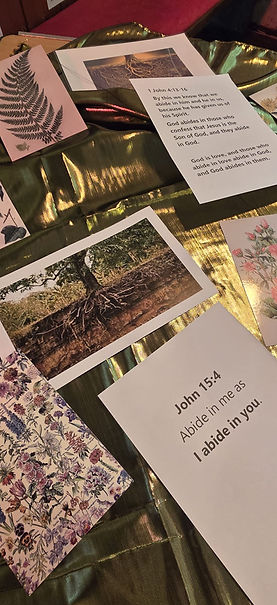
We had beautiful prayer stations, with tables of flowers, fruits, cards, a trellis to tie a ribbon on if we wanted to grow & bear fruit, a tree with lights to represent Jesus as the vine & we are the branches & we could write our names on a tag with a little heart on, hang it on the tree as a family coming together in Christ. We had an art table full of ideas for creative painting or collage, a LECTIO 365 session or to just walk around our beautiful church yard or sit under magnificent trees & take an hour & a half out, to be, talk, pray, listen to the whispers of our Heavenly Father, to take the hand of Jesus & be led wherever, to stop & listen to the birds & to be open to the Holy Spirit taking us on the journey. Even two green finches sounded as though they were calling us to come more closely into the presence of Jesus.
I have never known an hour & a half go so quickly, & that was just the morning!
We shared a deliciously simple lunch together around tables inside & out, chatting about the wonders of the morning.
The afternoon started at 13.30 with a choice of a completive walk, praying in small groups or continuing quietly in any of the prayer stations of the morning.
We then gathered together in church & had a time of worship, a talk by Hazel Marchment on pruning by an expert gardener, showing us how the hard or gentle pruning of plants, trees & shrubs brings stronger growth & produces better fruits just as our Heavenly Father in the right seasons of our lives prunes us, to bear the best fruits in each one of us & so bring glory to our amazing God.
Following this, we had a short time of sharing our experiences of the day & brought our artwork or anything we could show what God had been speaking to us about & placed it on the alter.
To close we shared & celebrated a short communion service where again we met with God, thanking Him for Jesus & for leaving us with His Spirit to bring us closer in the ways of Jesus.
There is no doubt we were refreshed, restored & full of joy as we had been guided on how to spend quality time God our Father
Written by
Anne Hemmings & Rev Barbara Irving